
About me
I am an Assistant Professor in the Department of Computer Science at the Universitat Autònoma de Barcelona (UAB), where I teach and do research in Computer Vision and AI. Most of my work is on biometric applications, such as person recognition in challenging real-world scenarios (tiny, distant, or infrared faces) with models small enough to run on edge devices, and keeping those systems secure and private.
I did my B.Sc. and later Ph.D. in Computer Science in Mexico at Tecnológico de Monterrey, with my M.Sc. in Computer Science at Stevens Institute of Technology in New Jersey. I also have industry experience from my time at Dell before doing my Master’s. My Ph.D. thesis on real-time very low resolution face recognition received second place in the Mexican Society for Artificial Intelligence’s award for best doctoral thesis. Before coming to Barcelona, I was a Postdoctoral Researcher at Tecnológico de Monterrey, at Inria in Rennes, France, and at the Idiap Research Institute in Martigny, Switzerland. I have also mentored undergraduate research through the Google CSR program with LatinX in AI, and I speak Spanish, English, French, Japanese, a bit of German, and I’m currently learning Catalan.
🔬 Latest research
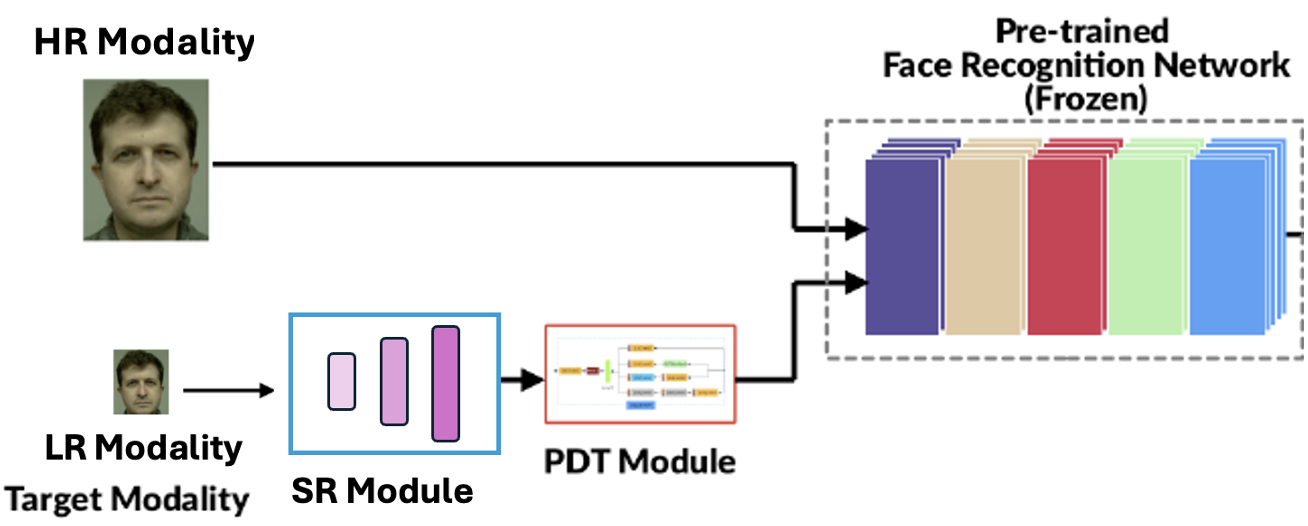
Improving Low-Resolution Face Recognition under Limited Data: How Synthetic Data Generation Can Close the Domain Gap
Published in IEEE International Joint Conference on Biometrics (IJCB) 2026, Focus Session on Generative AI for Fair and Secure Biometrics under Limited Data, 2026
Face Recognition (FR) systems in surveillance settings often encounter Low Resolution (LR) faces, those whose face region falls below the standard 112 × 112 input size. While labelled High Resolution (HR) training data is abundant, labelled native-LR data, and above all paired native-LR/HR data, is scarce. One workaround is to synthesize LR data from the available HR faces, but how much synthesis effort is repaid in recognition accuracy remains unclear. We present a study of simple synthetic generation strategies for a compact, edge device-oriented face recognition system, spanning interpolation-based degradation, knowledge distillation, a Prepended Domain Transformer (PDT), Real-ESRGAN-style degradation, and a learned Super Resolution (SR) front-end with an identity-aware loss. We evaluate these strategies on synthetic cross-resolution face benchmarks (LFW, CFP-FP, AgeDB-30) and on TinyFace, a real-world native LR dataset, and expose a synthetic–real gap: the degradation setting that is optimal on synthetic benchmarks is not the one that is optimal on real LR. We find that more synthesis effort does not help monotonically: the learned SR front-end does not surpass a direct feed of the aligned LR image into a strong backbone, while simple interpolation augmentation of a compact backbone is the only synthesis that improves over its own baseline. We conclude that generative methods for LR face recognition must be validated on real LR and against a direct-feed baseline, and release our pipeline at https://idiap.ch/paper/synth-lrfr.
Luis S. Luevano, Ünsal Öztürk, Hatef Otroshi Shahreza, Anjith George, Sébastien Marcel. "Improving Low-Resolution Face Recognition under Limited Data: How Synthetic Data Generation Can Close the Domain Gap". IEEE International Joint Conference on Biometrics (IJCB) 2026, Focus Session on Generative AI for Fair and Secure Biometrics under Limited Data.
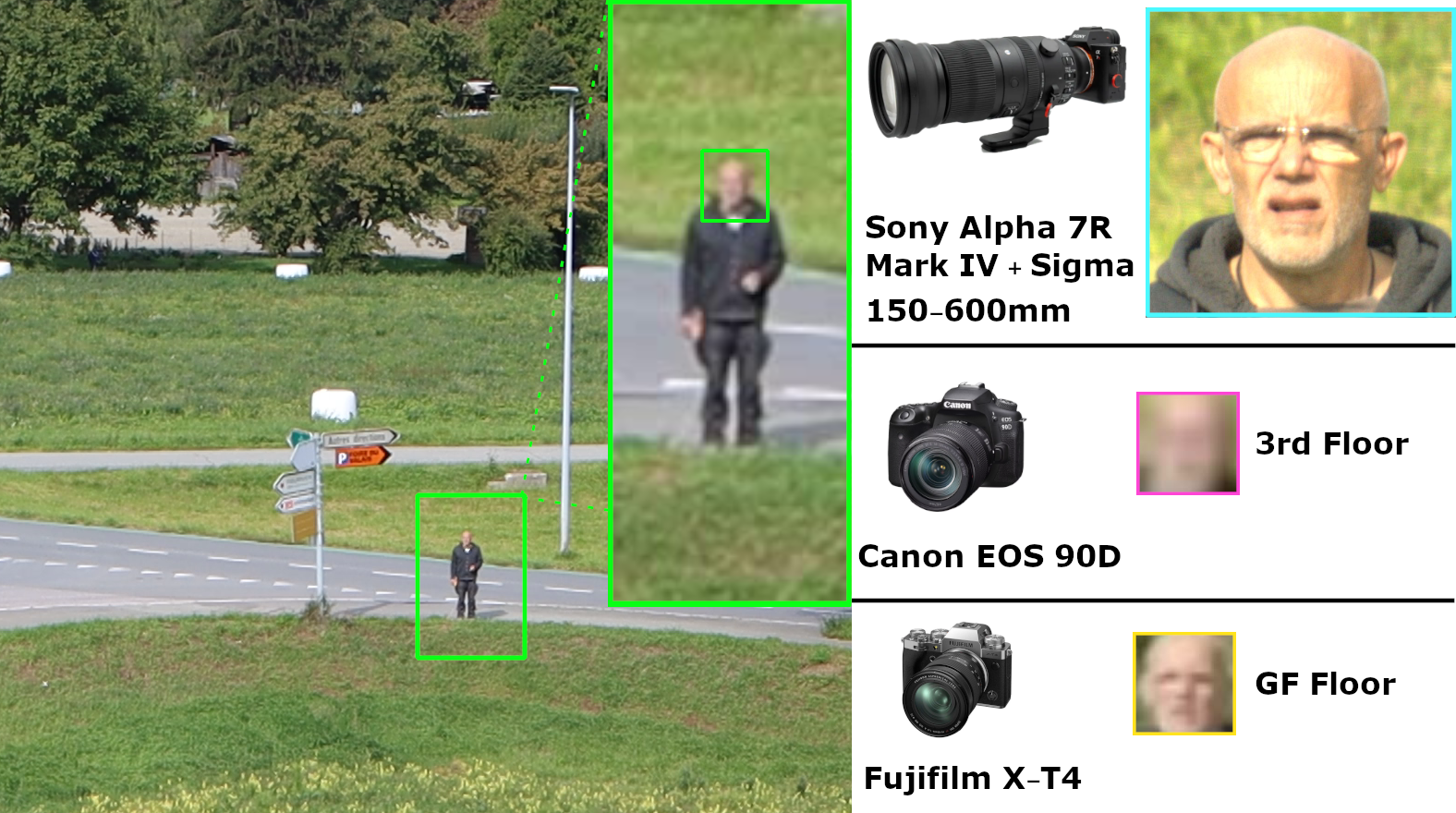
GaitFace: A Multimodal Dataset for Long-Range Person Identification
Published in IEEE International Joint Conference on Biometrics (IJCB) 2026, 2026
Efficient border control is becoming a significant global challenge, mainly due to severe congestion and extended passenger waiting times. To mitigate these bottlenecks and facilitate passenger flow, biometric technologies are increasingly deployed to streamline identity verification and enhance crossing efficiency. Technical limitations frequently impede biometric identification, particularly in long-range surveillance, where systems must deal with adverse atmospheric conditions and degraded image quality. While high-quality frameworks like BRIAR exist, they are frequently restricted to specific government agencies. This paper introduces GaitFace, a new public dataset that contains face and gait data captured at long distances. To ensure that the research reflects authentic border scenarios, we use Pre-Enrollment data, where a traveler registers via a mobile device, and “In-the-Wild” captures, which records individuals at a distance across multiple viewing angles and different cameras. Benchmarking SOTA face and gait models reveals that current architectures fail under low-resolution and elevated viewpoints despite success with optical assistance. GaitFace exposes these critical vulnerabilities, providing a rigorous public benchmark to drive more robust, unconstrained biometric research.
Alain Komaty, Luis S. Luevano, Vidit Vidit, Anjith George, Zeina Al Amine, Sébastien Marcel. "GaitFace: A Multimodal Dataset for Long-Range Person Identification". IEEE International Joint Conference on Biometrics (IJCB) 2026.
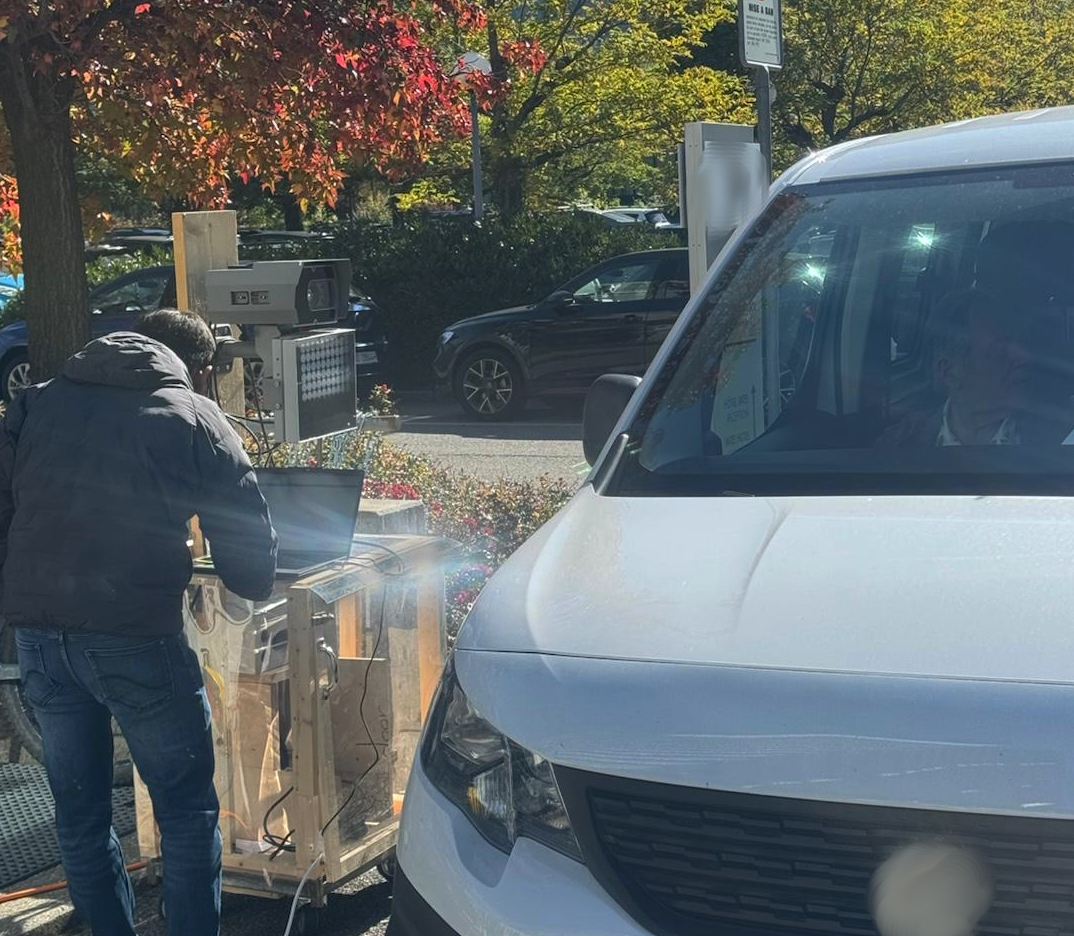
DriveFace: A Cross-Spectral Through-Glass Face Dataset for On-the-Move Vehicular Border Control
Published in IEEE International Joint Conference on Biometrics (IJCB) 2026, 2026
The continuous growth in cross-border mobility places increasing pressure on existing border control infrastructures, motivating on-the-move biometric authentication, in which travellers are identified directly inside their vehicles at checkpoints. Face recognition is well-suited to this setting, as it can be acquired passively and at a distance. Its development, however, is hindered by the lack of representative datasets: existing benchmarks are collected in controlled environments and do not capture the challenges inherent to vehicular acquisition, including motion blur, variable illumination, occlusions, and cross-spectral enrollment. To address this gap, we introduce DriveFace, a dataset for on-the-move face recognition in border-control scenarios, comprising NIR vehicle-crossing videos paired with smartphone-based pre-enrollment data. Baseline evaluations with state-of-the-art models show clear performance limitations under these realistic conditions, highlighting the need for dedicated methods to advance the field.
Anjith George, Luis S. Luevano, Alain Komaty, Zeina Al Amine, Vidit Vidit, Sébastien Marcel. "DriveFace: A Cross-Spectral Through-Glass Face Dataset for On-the-Move Vehicular Border Control". IEEE International Joint Conference on Biometrics (IJCB) 2026.
See all papers on the Publications page.
🗂️ Datasets and code
- GaitFace: long-range face and gait dataset (IJCB 2026)
- DriveFace: cross-spectral through-glass in-vehicle face dataset, with benchmark code (IJCB 2026)
- Synthetic data generation for low-resolution face recognition: code and pipeline (IJCB 2026)
- AgeSynth: identity-preserving aged and de-aged synthetic face dataset and code (IJCB 2025)
More on the CV.
📰 News
- 2026-09 🇮🇹 Presented three papers at IJCB 2026 in Rome: two oral presentations and one poster. The datasets and code are publicly available.
- Oral, Focus Session on Generative AI for Fair and Secure Biometrics under Limited Data: Improving Low-Resolution Face Recognition under Limited Data: How Synthetic Data Generation Can Close the Domain Gap (slides, code)
- Oral: GaitFace: A Multimodal Dataset for Long-Range Person Identification (slides, dataset)
- Poster: DriveFace: A Cross-Spectral Through-Glass Face Dataset for On-the-Move Vehicular Border Control (slides, dataset, code)
- 2026-09 👨🏻🏫 Teaching Database Management and Administration (102741) at UAB this semester.
- 2026-08 ❗Started position as Assistant Professor at the Autonomous University of Barcelona (UAB) 🇪🇸👨🏻🏫
- 2026-07 📜 Three of our papers were accepted at IJCB 2026 ! 🔥
- Main conference:
- Focus Session “Generative AI for Fair and Secure Biometrics under Limited Data”:
- 2025-07 📜 Our paper “Identity-Preserving Aging and De-Aging of Faces in the StyleGAN Latent Space” was accepted at IJCB 2025 !
- See paper page here
- 2025-05 📜 🇨🇭 I will be presenting a poster and demo for “Identity-Preserving Aging and De-Aging of Faces in the StyleGAN Latent Space” at the 2025 Martigny Biometrics Workshop.
- See poster here
- 2024-08 📜 SwiftFaceFormer: An Efficient and Lightweight Hybrid Architecture for Accurate Face Recognition Applications was accepted in the main conference proceedings of ICPR 2024, after being accepted for an oral presentation at the ICML 2024 LatinX in AI workshop (June 2024).
- See more: paper page, ICML LatinX in AI poster
- 2024-06 🧑💻 🇨🇭 Joined the Biometrics Security and Privacy Group at the Idiap Research Institute as a Postdoctoral Researcher!!
- 2024-04 📜 Face Anti-Spoofing paper accepted at the 5th Face Anti-Spoofing Workshop and Challenge @ CVPR2024!
- 2024-03 Presented “Towards a ML-enabled Decentralized Data Vault” for the SOTERIA project at the Forum InCyber at Lille, France
- See slides here
- 2024-01 Interview at Tec Sounds radio!
Older news (2022–2023) is in the news archive.