Published in IEEE International Joint Conference on Biometrics (IJCB) 2026, Focus Session on Generative AI for Fair and Secure Biometrics under Limited Data, 2026
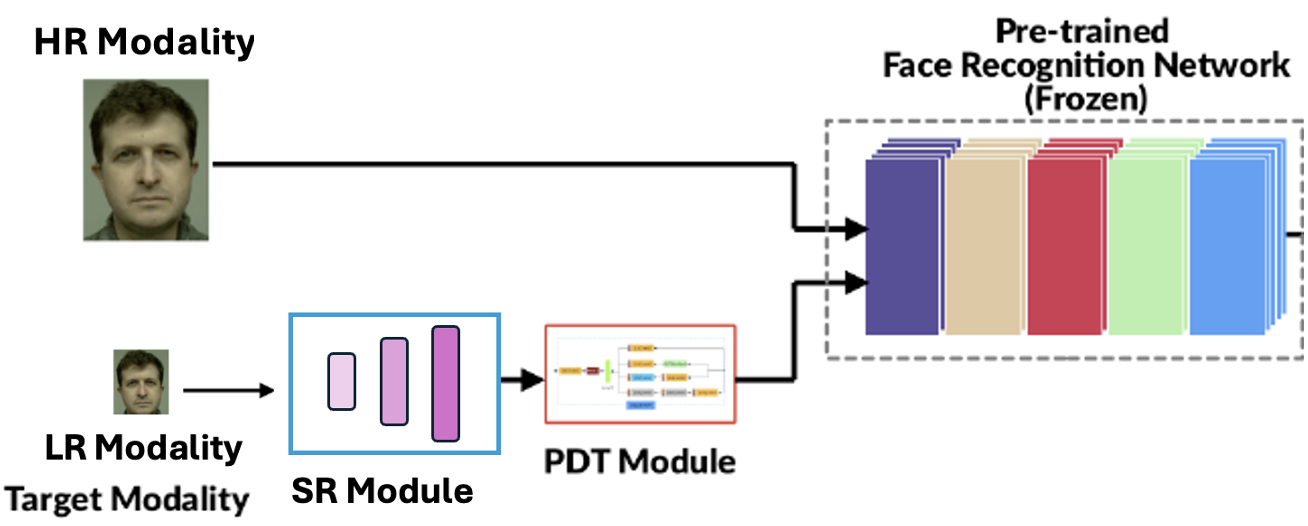
Face Recognition (FR) systems in surveillance settings often encounter Low Resolution (LR) faces, those whose face region falls below the standard 112 × 112 input size. While labelled High Resolution (HR) training data is abundant, labelled native-LR data, and above all paired native-LR/HR data, is scarce. One workaround is to synthesize LR data from the available HR faces, but how much synthesis effort is repaid in recognition accuracy remains unclear. We present a study of simple synthetic generation strategies for a compact, edge device-oriented face recognition system, spanning interpolation-based degradation, knowledge distillation, a Prepended Domain Transformer (PDT), Real-ESRGAN-style degradation, and a learned Super Resolution (SR) front-end with an identity-aware loss. We evaluate these strategies on synthetic cross-resolution face benchmarks (LFW, CFP-FP, AgeDB-30) and on TinyFace, a real-world native LR dataset, and expose a synthetic–real gap: the degradation setting that is optimal on synthetic benchmarks is not the one that is optimal on real LR. We find that more synthesis effort does not help monotonically: the learned SR front-end does not surpass a direct feed of the aligned LR image into a strong backbone, while simple interpolation augmentation of a compact backbone is the only synthesis that improves over its own baseline. We conclude that generative methods for LR face recognition must be validated on real LR and against a direct-feed baseline, and release our pipeline at https://idiap.ch/paper/synth-lrfr.
Recommended citation: Luis S. Luevano, Ünsal Öztürk, Hatef Otroshi Shahreza, Anjith George, Sébastien Marcel. "Improving Low-Resolution Face Recognition under Limited Data: How Synthetic Data Generation Can Close the Domain Gap". IEEE International Joint Conference on Biometrics (IJCB) 2026, Focus Session on Generative AI for Fair and Secure Biometrics under Limited Data.
Download Paper